
Holmes County Projected Release Dates
MDOC uses the exact public label Tentative Release Date. “Projected” is the common search phrase, but tentative is the correct term for the field in Mississippi’s public offender result. It is forward-looking and conditional. It is not the timestamp when a person crossed the facility threshold, and it is not a promise that all other legal holds will be clear.
MDOC’s handbook separates parole dates, earned-release-supervision dates, tentative release or discharge dates, and maximum release dates. Those milestones answer different questions. A parole eligibility date marks when consideration may occur. An earned-release-supervision date concerns a conditional form of release. A maximum date marks another sentence limit. The actual event belongs in the effective release/discharge record or central time sheet.
A local pretrial booking has a different framework. No sentence has yet supplied a term to compute. Bond, dismissal, remand, plea, trial, credit, and other holds can control the next step. Remand means the court directs continued custody. The court order explains the legal authority, while the Holmes facility’s record confirms the physical exit or transfer.
A county sentence can have a calculable end, but the research found no published Holmes formula, release schedule, or weekend practice. Ask the records custodian which credits are reflected and what the displayed or quoted date means. Do not import another county’s rule. A local calculation and an MDOC state computation can differ because they answer different custody terms.
Find Holmes County Release Dates
Start by identifying whether the person is a Holmes local detainee or an MDOC state offender. The Holmes/Humphreys complex houses both layers at the same Highway 12 site. The building name alone does not identify the correct records owner. An MDOC number is a strong sign that state sentence records matter; a local booking or cause number points toward the Sheriff and court.
- Identify the custody layer and collect the full name, date of birth, MDOC or booking number, conviction county, and cause number when available.
- For an MDOC offender, use the official MDOC Inmate Search. Search by MDOC ID when known, otherwise by name.
- Open the matched detail and record the current location, location-change date, sentence data, and exact Tentative Release Date label.
- Check the separate MDOC parolee search when parole may apply. A parole record does not equal full sentence discharge.
- For a local sentence or pretrial case, ask the Holmes facility for the booking/release record and the court clerk for the filed order and jail-credit terms.
- When an actual state discharge remains unclear, request the MDOC time sheet and effective release/discharge record.
The manifest capture of the MDOC offender search shows the official name and MDOC ID entry points used for a Holmes County release-date check.
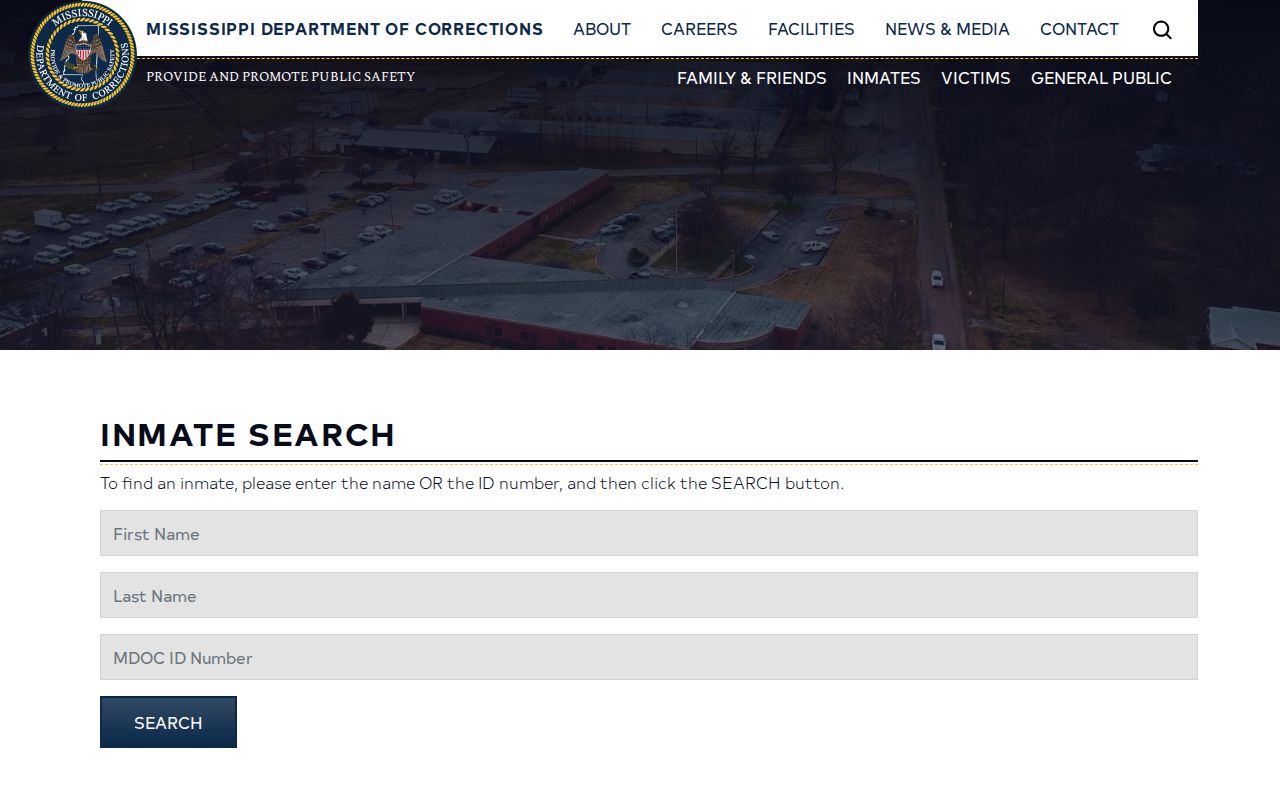
The search begins the state inquiry. A name match should be checked against the identity, conviction, sentence, and location data before the tentative date is recorded.
Note: A missing MDOC result does not prove a Holmes County detainee was released or discharged.
Holmes County Tentative Release Field
The public MDOC detail can show name, MDOC ID, date of birth, physical description, entry date, current unit, location-change date, sentence count and length, offense, county of conviction, sentence date, and an offender photograph. The verified detail layout also includes “Tentative Release Date.” The research did not verify a historical public detail that plainly labels every former offender “Released” or “Discharged.”
The official MDOC detail example demonstrates the field layout. It is a current-custody layout example, not proof about a released Holmes County person.
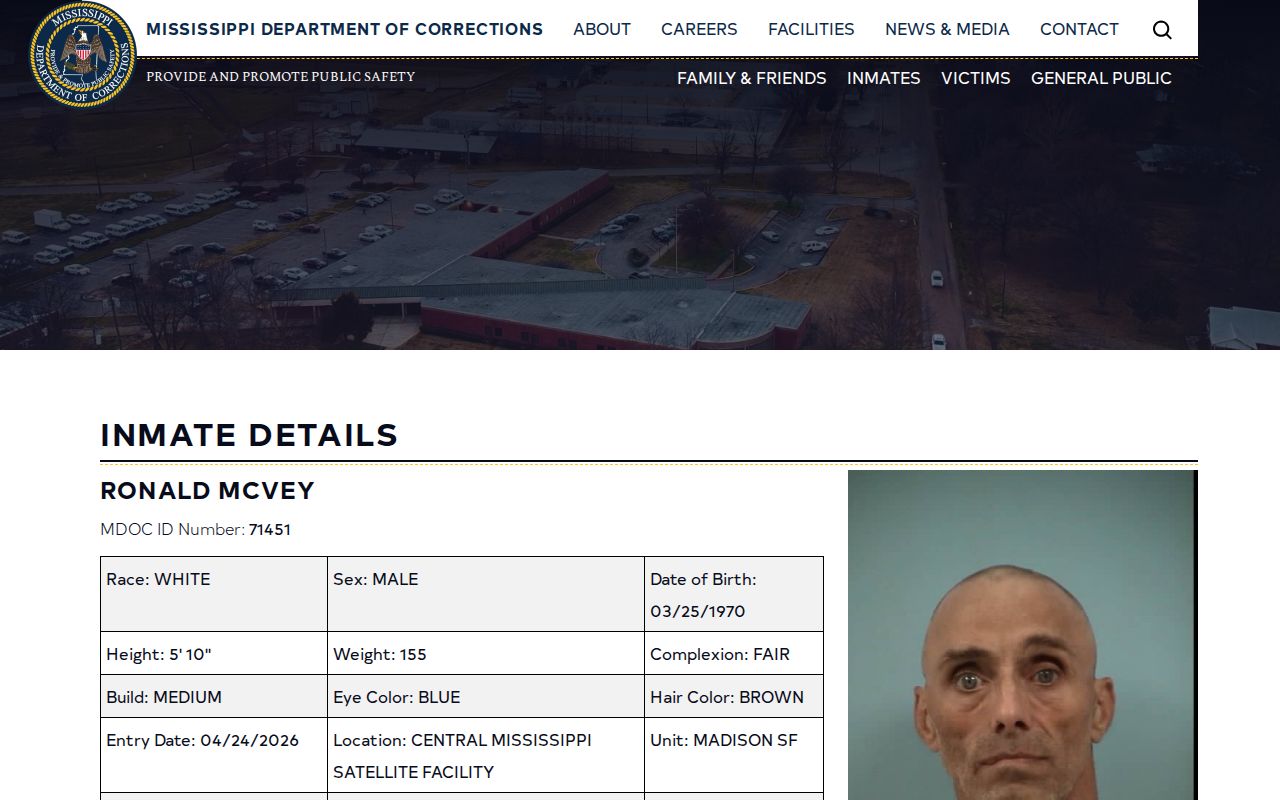
The image shows where the state places the estimate among sentence and location details. It must not be captioned or interpreted as a completed release.
A blank date, missing location, no result, or location change does not establish discharge. MDOC states that it does not warrant completeness or accuracy or commit to web updates. Ask Records for the time sheet, jail-credit entry, and effective release or discharge dates when the public fields are unclear.
Holmes County Release Date Math
Holmes County jail credit creates a local input to the state calculation. The MDOC handbook explains that allowable presentence or pretrial credit must connect to the cause number for which the person is incarcerated. MDOC seeks credit information from the county of conviction and deducts allowable credit from the earliest sentence date to establish the sentence-begin date.
That rule makes simple calendar math unsafe. The Holmes sentencing order and credit record may be needed alongside MDOC’s time computation. Time spent in custody on a different cause number cannot simply be moved into the sentence by assumption. If the credit appears wrong, obtain the filed court record and ask MDOC Records to review the specific credit entry.
This distinction is the key Holmes County computation quirk. The public field shows an output, while the cause-linked jail credit may sit in separate court and MDOC records. A reader cannot reconstruct the whole calculation from a sentence length and web date alone. Keep each cause number tied to its own order and credit history.
The Holmes County Circuit Clerk is the route for felony judgments and later Circuit Court papers. Justice Court handles many misdemeanors and felony initial appearances. One case may therefore leave an early bond trail in Justice Court and a later sentence or credit record in Circuit Court. Match the cause number before asking MDOC to change an input.
Mississippi Earned-Time Release Rules
Mississippi Code section 47-5-138 provides that an eligible sentence imposed after June 30, 1995 may receive four and one-half days of earned time for each thirty days served, based on MDOC’s good-conduct and performance decision. The allowance ordinarily cannot exceed fifteen percent of the term. That cap is the source of the common “serve eighty-five percent” shorthand.
The shorthand is not a universal answer. The statute includes a different cap treatment for certain people under twenty-one who committed a nonviolent offense. Older sentences can operate under another framework. Offense type, sentencing date, habitual status, age-based rules, forfeiture, consecutive terms, jail credit, detainers, parole, revocation, and amended orders can all matter. Do not subtract fifteen percent from the sentence and present the result as a Holmes County release date.
Earned-release supervision, often shortened to ERS, is also not full discharge. Under the statute, an early-released participant remains under MDOC jurisdiction and retains inmate status until sentence expiration. MDOC describes ERS as discretionary and tied to an approved in-state residence. Several offense, sentence, detainer, forfeiture, and status limits can block or change that route.
Note: Use the current statute and MDOC time sheet rather than a universal eighty-five-percent release calculator.
Why Holmes County Release Dates Change
A tentative date can move because a source input changes or because a later event affects the release path. The public detail does not expose every calculation input. When a date moves, capture the old and new display dates, then ask MDOC Records which entry changed. A court-derived issue should also be checked with the sentencing clerk.
| Factor | Possible effect | Record to check |
|---|---|---|
| Jail-credit verification | Moves the sentence-begin calculation | Cause-specific court credit record and MDOC time sheet |
| Earned-time award or forfeiture | Changes the conditional reduction | MDOC time computation |
| Consecutive or concurrent correction | Changes how terms combine | Sentencing order and MDOC calculation |
| Detainer or other hold | Can prevent community release or cause transfer | Named receiving-agency or hold record |
| Parole decision | May create, delay, deny, or rescind a conditional route | Board disposition and effective MDOC release record |
| Release-plan approval | Can affect ERS or parole timing | Central MDOC status record |
| Revocation or amended order | Can return a person to custody or alter the term | Court, Board, and MDOC records |
A detainer is a request or authority to hold or transfer someone for another agency. It can mean the sending custody ends while the next custody begins. A parole approval also ranks below the actual release record because conditions, planning, a detainer, or rescission can intervene before physical release.
Confirm Holmes County Release Dates
For a local detainee, contact the Holmes/Humphreys County Correctional Facility at 662-834-5016 or use the Holmes County Sheriff’s Department contact at 662-834-1511. Ask whether the person was held in the local booking layer and request the existing admission and release record. Pair its effective release time and reason with the relevant Justice or Circuit Court order. A court order may be signed before the facility clears other holds, returns property, and completes release processing.
For an MDOC offender, contact MDOC Records at 601-933-2889 or MDOCRecordsDepartment@mdoc.state.ms.us. Request the time sheet, jail-credit entry, and effective release/discharge dates using the MDOC number. A focused records request can distinguish parole, ERS, transfer, and full sentence discharge. The Holmes County release-record lookup explains how the local booking record and court disposition support that inquiry.
When the records unit cannot resolve the question informally, MDOC directs public-record requests to its Legal Division at 301 North Lamar Street, Jackson, MS 39201, by fax at 601-359-5735, or by email at legalpublicrecords@mdoc.state.ms.us. MDOC does not accept those requests by telephone. Ask for existing records, not a new date calculation, and specify the MDOC number, sentence or cause, time sheet, effective date, mechanism, and whether custody moved to parole, ERS, or another authority.
MDOC’s published policy lists fifteen cents per mechanically reproduced page. Work beyond the first hour, vendor cost, and postage may also be charged, and an estimate or prepayment can be required. Those state fees do not establish a Holmes Sheriff fee schedule. If a local record is needed, ask the Sheriff’s custodian for the accepted request method and cost before ordering copies.
MS SAVIN can supplement the official record with a time-sensitive custody-change alert. Register for the exact person and preserve the event text. The Holmes County VINE Inmate Check explains how a county registration can follow movement into MDOC or other custody. An alert should still be confirmed with the agency that entered it.
When two dates conflict, first confirm that both records concern the same person, cause number, and custody episode. Then compare the order date, effective date, physical departure time, event time, and web update time. Preserve each rather than choosing the earliest. The clerk can explain the filed order, the facility can explain its release entry, and MDOC can explain the state computation.